News

Creative Director/CEO of Emergency Exit Arts

In June 2026 I will join the wonderful EEA! I’m beyond delighted. Everything I’ve ever cared about is there. I’m honoured to pick up the reigns from the brilliant Daniel Bernstein and to step into this world of artists making beautiful change with communities (and a giant disco turtle). Please drop me a line if you’re interested in getting involved or working with us.

Here’s EEA’s LinkedIn post announcing it the appointment:

———————————————-

Welcoming our new CEO and Creative director Rachel Grunwald

We are delighted to share that Rachel Grunwald will join Emergency Exit Arts as our new CEO & Creative Director from 1 June.

Rachel brings 25 years of experience as a cultural leader, theatre director and community arts practitioner. Her career spans work with the Royal Shakespeare Company, Kiln, HighTide, Southbank Centre and SPID Theatre, alongside senior leadership roles at JW3 and Improbable. She is a Clore Fellow and a passionate advocate for creativity as a force for community connection and social change.

Rachel says:

“I am honoured to join EEA as Creative Director and CEO. Our communities are at risk of fracture; there is urgent work to be done to imagine a shared, hopeful future. I look forward to working with the team, artists and partners across the UK to deepen EEA’s impact as we approach our 50th anniversary.”

We also extend our heartfelt thanks to Daniel Bernstein Bernstein for his leadership and dedication and wish him every success in his future endeavours.

Here’s to an exciting new chapter for EEA as we continue to enrich people’s lives through creativity and extraordinary public art.
Artivist’s Handbook, Nov-Dec 2025

A show for SPID Theatre telling the story of Artistic Director Helena Thompson’s fight for a renewed community vision, and the eventual triumph of art and solidarity. The show had played for years in many other versions. As the ‘remount director’ I installed it in its final home, the beautifully refurbished Community Rooms where it all began.

Twenty years ago I directed “Open House ” a site-specific (fantastic) new play by Helena Thompson, in the mouldy and dilapidated community rooms of the Kensal House estate in Ladbroke Grove.

The kids from the estate banged on the doors and asked what we were doing, so we started drama classes for the little ones and I began to direct immersive new plays by Helena with the teenagers, on site.

The estate had been designed as a ground-breaking urban village by Maxwell Fry and Elizabeth Denby in the 1930s, and the community rooms were at the heart of the vision. Seventy years later, that dream was once again flickering to life. We worked in cold and damp, raised money project by project, revelled in the talent and energy of the young people, and celebrated each new storage heater, repaired toilet and blackout blind. But these were just sticking plasters.

How had the space come to this sorry state? Denby retired, Kensal House passed into council hands after the second world war and the vision faded away. All the love, inspiration, and belief in solidarity and community living, was forgotten. The rooms were – literally – left to rot, just as the council (Royal Borough of Kensington and Chelsea) left the flats above to decay, and left the people of Grenfell Tower vulnerable to catastrophe.

In the years since we started the youth theatre Helena has worked ceaselessly to create a community hub, build a thriving arts company that puts participants on estates at the heart of everything they do, and finally, restore the community rooms and unite with residents to force the council to restore the rest of the estate too. The black mould, leaks and floods which eroded residents’ physical and mental health will soon be things of the past.

Artivist’s Handbook told the story of her personal struggle to achieve the historic settlement with the council – and put a lift in a Grade 2* listed building with National Lottery Heritage Fund and Historic England support! – and showcases the voices of the local residents and SPID participants who championed the work and fought back against attempts to divide and turn the community against each other.

As for me, one thing stands out. I saw a previous version of this show called ‘Floods, Fire & Sunshine’ at Riverside Studios in June 2024. At the end, young people involved with SPID performed their own poetry – one of them looked familiar but I couldn’t place him. But he knew me. He’d grown up in Kensal House and he remembered that I had worked with his older sister nearly 20 years earlier through our ‘Far Far Away’ programme. He remembered a film we’d made in which she’d been stuffed into a wheely bin. Above all, he remembered being too young to join us, and how desperately he wanted to be a part of it.

And here he was, onstage, a brilliant artist, part of a company – a movement – that was making real change in the world. Bravo to him, bravo to Helena Thompson, and bravo to SPID and all who fight for arts and community.

Goodbye Improbable, Hello Whatever’s Next

This month, after a wonderful two years at Improbable, my fixed-term contract as ‘Strategic Lead for The Gathering’ comes to an end.

(The headline’s not quite right… it’s not goodbye to Improbable, it’s actually the start of a beautiful relationship and we’re already thinking about what’s next… but it’s goodbye to this particular role, for now)

I’ve loved being with Improbable and learning with them. The deep listening, tolerance for uncertainty, and fearless, persistent responsiveness that drive emergent and improvisatory practice. The principles of self-organisation that underpin Open Space technology. The acknowledgement that when we work on what we love we do it with our full selves. I’ve heard others parrot: ‘people first, work second, always” but I’ve never lived it till now.

I know more about the early stages of a capital project, what it means to ‘engage multiple stakeholders’ (although I still don’t like the phrase!) and how to keep a company connected and its spirit nourished at a time of change. I know more about local, national and regional government and creative industry support structures – and that all makes me even more certain that learning with and through the arts in State schools is what really matters.

I finally understand what “Strategic” actually means! (It’s long-term storytelling.)

And I understand more about myself and my strengths. Building community and relationships. Using stories and images to share ideas clearly and passionately. Connecting people to each other and these ideas in pursuit of a vision I am proud to stand behind.

With another hat on I’m also – for the first time since having my middle child – working as an artist myself on the R&D of a piece of new movement theatre which is too precious and scary to say more about here (yet).

I’m looking for my next challenge and (in true Improbable style!) I’m open as to what that might be. Previously I’ve lead volunteer activist groups to effect political change, supported community arts organisations to create lasting social change over decades, run a large and complex department through Covid (with ALL the HR), advocated, budgeted, strategically planned, fundraised, consulted, advised and collaborated with others to create many meaningful pieces of art. I also speak and write publicly and am very happy as a representative/ambassador.

Please get in touch if you’d like to have a conversation.

Far Far Away

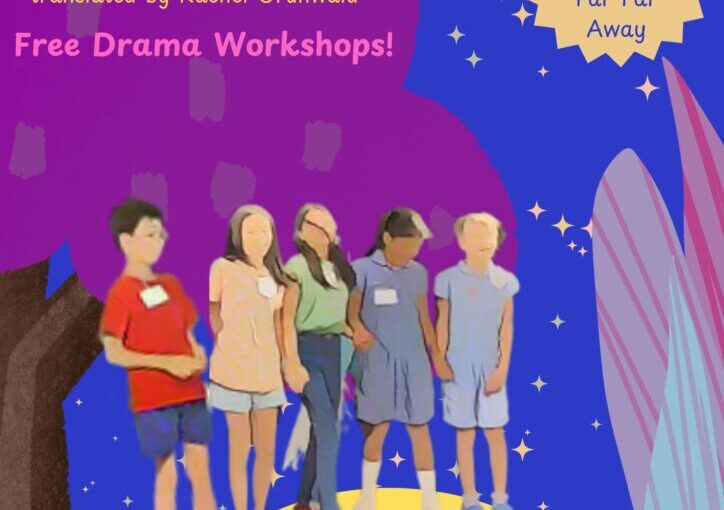
A transporting arts programme for children aged 8-13 which I co-founded nearly two decades ago. This September I went back to facilitate some sessions in SPID Theatre’s beautifully renovated community rooms at Kensal House.

In 2006, SPID’s Artistic Director Helena Thompson and I started working with the children and young people on the Kensal House estate in Ladbroke Grove. The resident kids banged on the door whilst we were rehearsing a play in the derelict community rooms in late 2005 and asked what we were doing. That’s how SPID Theatre’s youth work began, and how we took up residence on the estate.

You can read about the remarkable story of Kensal House and SPID in my news post from Dec 2025 called ‘Artivist’s Handbook’. Or search the web to read about it in the national press, and watch BBC coverage of the company’s (successful) fight with the Royal Borough of Kensington and Chelsea.

But this is a different story. In those early years of SPID Helena managed to secure funding for us to create a series of new, immersive plays with the teenagers. It was amazing. Large casts of local young people led audiences from scene to scene, whirled them around on wheeled benches with UV murals flashing all around, created buses and bus stops indoors, and worked with a passion, dedication and talent that was exhilarating.

But something wasn’t right. All the funding we were getting came with strings – the work needed to be about knife crime, gang crime, bullying. All the things older people who didn’t really know these young people thought they would be interested in.

And this didn’t sit right with me. I felt that theatre should be about getting away from the here and now, dreaming of things that you’d never seen, playing out ideas and feelings and circumstances very far from your own, and making space for the imagination to take flight. I was bored and frustrated with working with these talented young people in their own clothes, own language and familiar scenarios. Couldn’t we take them far far away, I asked?

So ‘Far Far Away’ was born. A new programme for younger children, aged 8-13, where the subject matter would always be from a time or place far far away from the here and now.

We started with a drama project, ‘My Star’, a beautiful French play by Jean-Claude Grumberg, about intergalactic penpals – one from a planet where the people have the heads of leeks, and another where the people have potato heads. The children go on adventures including a star safari and create a monster which gets out of control.

Over the years Far Far Away expanded to include artforms including animation, radio, film and more.

And this month, many years since I stopped running the programme and it was taken over by SPID’s brilliant outreach director Nnenna Samson, I went back and led a block of sessions on ‘My Star’ with a new group of young people, who loved it as much as their predecessors nearly 20 years ago.

For more information about the programme, click here.

What Next for Jewish Theatre in the UK?

In 2024 I worked with Shoresh Charitable Trust to help them understand the landscape of UK Jewish Theatre, so they could better invest in its future.

I introduced Shoresh to Improbable and we decided to work together to host an Open Space event – an improvised conference in which the agenda is made up on the spot by participants. There are no expert panels or keynote addresses because the wisdom is acknowledged to be present and distributed in the group. Here’s the invitation we sent out:

What next for Jewish Theatre in the UK?

We are at a time of great richness and possibility for UK Jewish theatre. There are a multitude of talented individuals and companies working across all theatrical forms and there is much ambition yet to be fulfilled. The horrific violence and loss of both Israeli and Palestinian life since October 7th have intensified the complexities of making Jewish work.

Shoresh Charitable Trust supports Jewish activities in the UK and Israel, and we would like to increase our involvement in UK Jewish theatre. We recognise that to do so meaningfully, we need to learn about the passions, frustrations and people who make up this exciting landscape. We want to hear from you, and we feel that now is the time.

How can we work together to harness the ideas, talent and possibility, and help artists and producers bring a greater variety of Jewish stories and discourse into UK culture? What support do you need to make meaningful work about Jewish themes or to use Jewish traditions, culture and learning to enrich your practice? What support can you offer?

What really excites you that you haven’t explored yet? What fears do you have? What hopes?

What would you like to learn or share about getting Jewish-themed work onto UK stages? What even is Jewish theatre? Are you looking for collaborators, partners or producers for a project? Join us to explore all this and connect with peers, and to ask many more questions of your own.

For the full invitation and more information about Open Space, click here.

Reports of the conversations can be found here.

The image at the top are visual minutes by the brilliant Beatrice Baumgartner-Cohen.

Our Ability to Champion Difference…

Something strange happened to me in 2023.

As I’ve grown older my Jewish practice has become increasingly important to me, and is a large part of how I understand life, time and community… but I’d always said I never wanted to make work or write about the Holocaust, antisemitism or Israel.

Well, in Jan 2023 I published an Op-Ed in the Times about what remembering the Holocaust means to me, and then in December 2023 I found myself so upset about the discourse around me that I put pen to paper and wrote this for the Jewish News, and online UK newspaper.

Here it is:

https://www.jewishnews.co.uk/opinion-jews-ability-to-champion-difference-is-a-great-assetso-why-not-on-israel/

Improbable!


I am beyond delighted to have joined the mighty Improbable Theatre Company as Strategic Lead on The Gathering, the artistic search for a home.

A home for Improbable, who have never had one before. A home for improvisation, and a home for artists who have not had a home elsewhere.

A space for regeneration and creation, for relationships, for dreaming.

And part of Improbable’s legacy to the arts and to the world more broadly.

The story is just beginning to take shape and I’m honoured to be one of the people telling it.

You can read about the project here


Why I Won’t Be Visiting Auschwitz with My Family – The Times Op-Ed for Holocaust Memorial Day 2023

For Holocaust Memorial Day 2023, I put pen to paper about some thoughts and feelings I’d had inside me for a long time. It was published in The Times (behind their paywall). I had an astonishing response from people who opened up, for the first time, about similar feelings – or about ideas and thoughts they’d had but never crystallised. If this speaks to you, please comment below.

The full text is here:

My sister and I used to climb up the tiled walls of our narrow upstairs toilet, pressing the soles of our feet against one side and our backs against the other. It was fun. It was also a huge relief to me that I could climb higher than the level of the doorframe, so that if the Nazis ever came I could hide up there. When they looked in the toilet they wouldn’t find me.

I probably wasn’t the only child to pick my nose and eat it. I doubt, however, that there were many others who wondered whether doing so would help them survive longer in Auschwitz. This was not straightforward – I would after all have required sustenance to create the nose pickings before I could eat them – and I puzzled over this for hours, just as I spent hours wondering why I couldn’t levitate by winching my feet off the floor with pulleys attached to my shoulders like dungarees. I puzzle over this now, because the childishness of these thoughts makes me realise how very young I must have been when I first knew about the horrors of the concentration camps. I don’t remember how old I was. Perhaps I don’t ever remember not knowing.

Later this year I am going with several family members to visit, for the first time, the small village in the former Czechoslovakia where my paternal grandfather lived before his family were murdered. My three siblings and I are going a day earlier. They will spend the day in Auschwitz. I have chosen not to join them. Why not?

As a child I had a recurring nightmare. My family was being chased, by the army, the police or the state – people in uniform at any rate – and we had to flee, because we were Jewish. I had the dreams for years. I even remember the front garden and door of one of the houses we fled. Again, I don’t remember my age, or, except for one, the actual stories I heard which prefigured them. My maternal grandmother was an 8 year old girl in Lodz during the time of the pogroms. One day she was met by a neighbour who told her that it wasn’t safe to go home, and that she should go straight to the train station after school. She never went home again.

At some age I started reading. The Silver Sword, I am David, When Hitler Stole Pink Rabbit, The Diary of Anne Frank, MAUS, Primo Levi, Elie Wiesel, The Upstairs Room, The Hidden Children, children hidden in cupboards, under sheds, in mud holes… I read and read and read until by about 12 I was so sated that I was reading out of grim compulsion. Horror porn, for thrill and grotesque curiosity. I especially sought out pictures. How thin could a person get? Could I find a photograph which showed in any detail the dark sores on the cadaverous bodies?

And now those stories are inside me. So deep that they’ve grown into the rest of my experiences and memories like a surgical mesh embedded in tissue. So no, I am not going to visit Auschwitz. I do not need to visit Auschwitz. People say you need to be there, feel your feet on the ground. I feel my feet on the tile of my

toilet walls. For better or for worse all the lessons are inside me. The shadow of history is a part of me. Actually, not a shadow. A shading. The shade of light and dark, the sadness with the joy, the sound of glass smashing at a wedding.

For better or for worse? This too takes some puzzling out. The childish relief at finding a place to hide has matured but not vanished; now, when my children argue and won’t shut up I think, why won’t they listen to me? They must listen to me. If I ever need to keep them quiet and hide them in a shed with a huddled group of terrified people, we would die.

But for better… there is much here. Solidarity with the persecuted, marginalised or vulnerable, whoever they are. It is second nature to me to feel kin to the descendants of Black slaves and all those who inherit their stories. I feel the tragedy of the Uigur, the refugees crossing borders. I feel the casual harassment and attacks on Muslims in hijab and beards on UK streets just as I feel the attacks on ultra-orthodox Jews. There is no hierarchy in genocide or persecution. No use in being the top corpse in the pile. I am connected to the world in a very particular way, as are so many Jews who carry forward the message of Never Again.

I wish that I didn’t have to teach this to my children. I will. But I fear that once you learn that humans are capable of such cruelty, it immediately makes it imaginable, rather than unimaginable. A goalpost you can see past.

My Jewish community, culture and practice is a constant source of pleasure to me: lighting candles and singing with my family on a Friday night; being greeted by friendly faces at synagogue and knowing that if I’d had a bad week, or suffered a bereavement, I’d be recognised and supported; enjoying the music, stories, food and noisy argument which characterise my cultural life, and connecting to an epic and poetic literature, and an unbroken tradition of practice and celebration that insists on the importance of the things in life that can’t be touched.

I can’t disentangle any of that from the shade of the Holocaust. And I do not need to venture any further into that shade. I do not need to have my feet on the barrack floor to actually feel the horror, or to understand the abject destruction that follows from prejudice and hatred. My feet are on the tiles. The challenge is to do good with that learning.

And that is why I am not going to visit Auschwitz. I will spend a day by myself in Krakow. I will visit the central square and the castle and cathedral. I may eat pierogi and take a tram ride to the Nowa Huta. I will enjoy myself, and learn something new.